Unveiling the universe through history’s greatest scientific discoveries
Light in the Dark is a collection of the most captivating moments in our exploration of the cosmos. From the first glimpses through a telescope to the hidden structure of the universe, each discovery has revealed something profound about our place in the vast unknown.
The Andromeda Galaxy: A Universe Beyond Our Own
For centuries, astronomers thought the Andromeda “nebula” was just a cloud of gas inside the Milky Way. That view began to change in 1888, when Isaac Roberts took a long-exposure photograph that revealed a striking spiral pattern. A simple gas cloud couldn’t form such an orderly shape hinting that Andromeda, and perhaps other “nebulae”, might be something far larger and more distant.
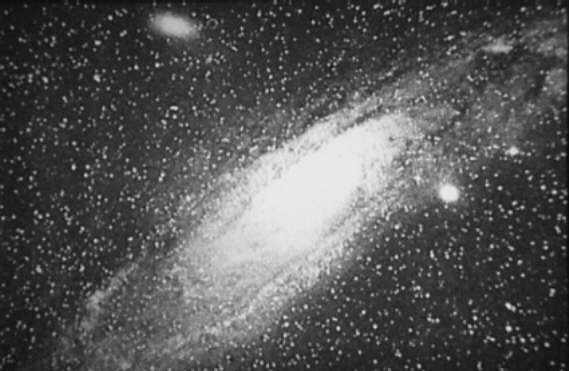
Andromeda ‘nebulae’ photographed by Isaac Roberts, 29 December 1888
In 1924, Edwin Hubble proved that the Andromeda “nebula” wasn’t a cloud within our Milky Way, but an entirely separate galaxy, showing for the first time that our universe contains many galaxies.
He did this using Cepheid variable stars, which get brighter and dimmer in a steady rhythm. Henrietta Swan Leavitt had found that the slower a Cepheid pulses, the brighter it truly is. By timing a Cepheid’s pulses, astronomers can tell its true brightness, then compare it to how bright it looks from Earth. The bigger the difference, the farther away it is! Hubble’s measurement put Andromeda millions of light-years beyond the Milky Way.
 Sam Hawke